VRF vs Chiller Systems: Both applications for HVAC in Large Buildings
What is a VRF System?
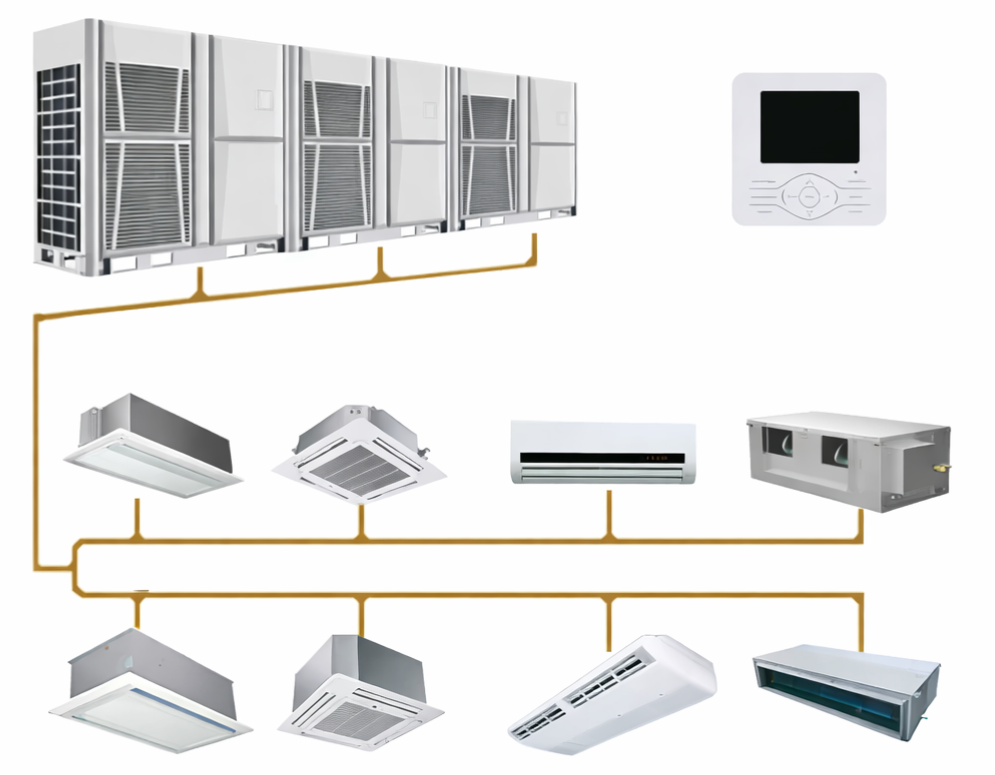
VRF stands for Variable Refrigerant Flow. The two terms are often used interchangeably. This technology refers to an air-conditioning system that uses refrigerant flowing through pipes to multiple indoor units, with the amount of refrigerant to each unit precisely controlled according to cooling demand.
The VRF system is ideal for buildings with multiple zones, rooms, or floors that may require different temperatures—such as multi-tenant office buildings, hotels, renovated buildings with limited space, and facilities where not all zones operate at full cooling load all the time.
VRF systems are highly flexible air-conditioning solutions that use refrigerant as the cooling medium. These systems allow multiple indoor units to operate on a single outdoor unit, making them ideal for large buildings with varying cooling needs.
What is a Chiller System?
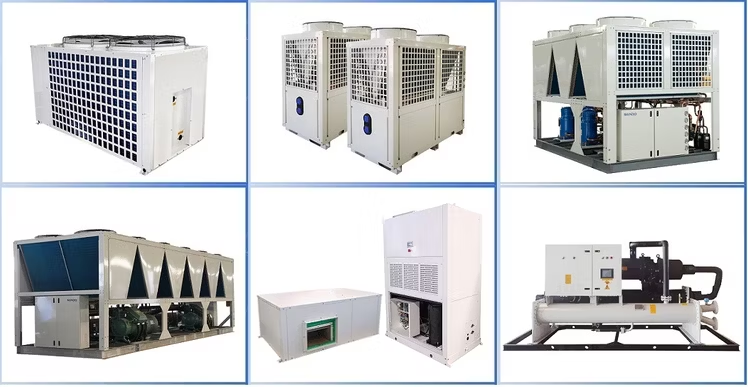
A Chiller system produces chilled water at a central unit and circulates it through pipes to indoor equipment such as AHUs (Air Handling Units) or FCUs (Fan Coil Units), where the chilled water absorbs heat from the air to provide cooling throughout the building.
The chilled water that has absorbed heat then flows back to the chiller unit to be cooled again, completing a continuous cooling cycle.
This system typically includes additional components such as water pumps, cooling towers, valves, control systems, and large piping networks.
Chiller systems are suitable for buildings with a high and continuous cooling load, such as shopping malls, factories, large hotels, high-rise office buildings, and expansive open spaces.
Chiller systems use water as a cooling medium and are commonly used for centralized air-conditioning in large infrastructure projects. These systems are known for their powerful cooling capacity and consistent performance
Advantages of VRF Systems
- Individual Temperature Control: Each room or zone can have its own temperature setting for better comfort.
- Energy Efficient Operation: Adjusts cooling based on demand, helping reduce energy usage.
- Compact Design: Requires less installation space, suitable for modern buildings.
- Flexible Installation: Easy to install in multi-floor and complex layouts.
- Quiet Performance: Operates with low noise, ideal for offices and hotels.
- Smart Control Integration: Can be connected with centralized and remote control systems.
- Zoned Cooling Flexibility: Different areas can be cooled based on individual requirements.
- Energy Saving in Partial Load: Works efficiently even when some areas need less cooling.
- Space Saving Outdoor Units: Compact outdoor units help in limited space installations.
- Easy Expansion: Additional indoor units can be added when needed.
- Modern HVAC Solution: Suitable for smart and energy-efficient buildings.
disAdvantages of VRF Systems
- Best for Zoned Cooling: Designed mainly for buildings with multiple zones.
- Requires Proper Design: Efficient performance depends on correct system planning.
• Multiple Outdoor Units for Large Projects: Large buildings may require more than one outdoor unit.
Advantages of chiller Systems
- High Cooling Capacity: Suitable for cooling very large buildings.
- Centralized Cooling: Provides uniform temperature across large areas.
- Reliable Continuous Operation: Designed for long hours of operation.
- Ideal for Large Infrastructure: Works well for malls, hospitals, and campuses.
- Long System Life: Built for durability and long-term performance.
- Scalable for Large Projects: Can support future building expansion.
- Uniform Cooling Distribution: Maintains consistent temperature across large spaces.
- Suitable for 24/7 Operation: Works efficiently in continuous-use buildings.
- Centralized Maintenance: Main components are located in one area for easy servicing.
- Ideal for Large Load Applications: Handles high cooling demand efficiently.
• Flexible for Campus Projects: Can serve multiple buildings from one system.
disAdvantages of chiller Systems
- Requires Plant Room Space: Needs dedicated area for installation.
- Detailed Planning Required: Installation involves proper infrastructure design.
- Longer Installation Time: Setup may take more time for large projects.
Applications of VRF Systems
VRF systems are ideal for buildings that need flexible and efficient cooling. They work well where different areas require individual temperature control.
Applications:
- Corporate office buildings
- Hotels and hospitality projects
- Retail showrooms
- Commercial complexes
- Educational institutions
- Luxury apartments
- Co-working spaces
- Restaurants and cafes
- Conference rooms and meeting halls
- Multi-floor business centres
VRF systems provide comfortable and energy-efficient cooling for modern buildings.
Applications of chiller Systems
Chiller systems are perfect for large buildings that require centralized cooling across wide areas. They are designed for high-capacity performance.
Applications:
- Shopping malls
- Large hospitals
- IT parks and corporate campuses
- Airports
- Universities and large schools
- Large hotels and resorts
- Industrial facilities
- Convention centres
- High-rise commercial towers
- Multiplexes and entertainment centres
Chiller systems deliver powerful and consistent cooling for large infrastructure.
combined Applications in large buildings
Both VRF and Chiller systems can be used in:
- Corporate campuses
- Large commercial buildings
- Mixed-use developments
- Business parks
- Healthcare facilities
- Hospitality projects
- Educational campuses
These systems help create comfortable, energy-efficient, and smart indoor environments.
How to Choose the Right System for Your Building
If you’re deciding between a VRF system and a Chiller system, consider the following key factors carefully to help you make a choice that’s as close to the right answer as possible.
1. Building Size and Cooling Capacity
If your building is not very large (for example, with a total cooling load of around ≤ 500 TR), a VRF system usually provides an excellent balance of efficiency and cost-effectiveness.
However, for larger buildings or those with high, continuous cooling demand, a Chiller system tends to be more economical in the long run.
2. Building Usage Pattern
If your building has zones that are not used all the time or areas that are turned on and off alternately, a VRF system is more suitable because it allows independent zone control.
In contrast, if the building operates full-time with high and steady loads, the Chiller system offers greater stability and performance.
3. Installation Budget and Long-Term Cost
If you need to minimize upfront installation costs, a VRF system is a smart option—it requires less equipment and space.
But when considering long-term value, especially for large-scale buildings, a Chiller system may be more cost-effective thanks to its longer lifespan and higher overall efficiency.
4. Temperature and Air Quality Requirements
If your building requires precise temperature control and enhanced air quality—for instance, air filtration or humidity control—a Chiller system combined with AHUs (Air Handling Units) clearly has the advantage.
5. Building Structure and Installation Space
Ensure that your building has enough space for a mechanical room, cooling tower, chilled water piping, and air ducts.
If space is limited, the VRV/VRF system is more convenient, as it doesn’t require a large mechanical room and offers flexible piping layouts.
6. Maintenance Team and After-Sales Support
A VRV/VRF system is generally easier to maintain and only needs periodic checkups, making it ideal for buildings without a dedicated maintenance team.
However, if you have an in-house engineering or technical team, a Chiller system can be efficiently maintained and optimized for long-term performance.
7. Hybrid System Design
Some buildings choose a hybrid approach for maximum flexibility—for example, using Chillers in zones with constant high loads, and VRV/VRF systems in office areas or guestrooms to reduce costs and improve energy control.
This hybrid configuration is even recommended by major manufacturers like LG for large-scale, mixed-use projects.
Conclusion
VRF and Chiller systems are both strong and efficient HVAC solutions for large buildings. The right choice depends on the size of the building, cooling requirements, and project design. With proper planning both systems deliver excellent cooling performance.
Alviz Electro India Pvt. Ltd. provides design, supply, and installation services for both VRF and Chiller HVAC systems based on your project requirements.
Disclaimer:
The blog posts on alviz. in are for informational purposes only. While we aim for accuracy, the content may not reflect the latest updates or specific advice. Alviz Electro India Pvt. Ltd. is not responsible for actions taken based on this information. For expert guidance, please get in touch with us.